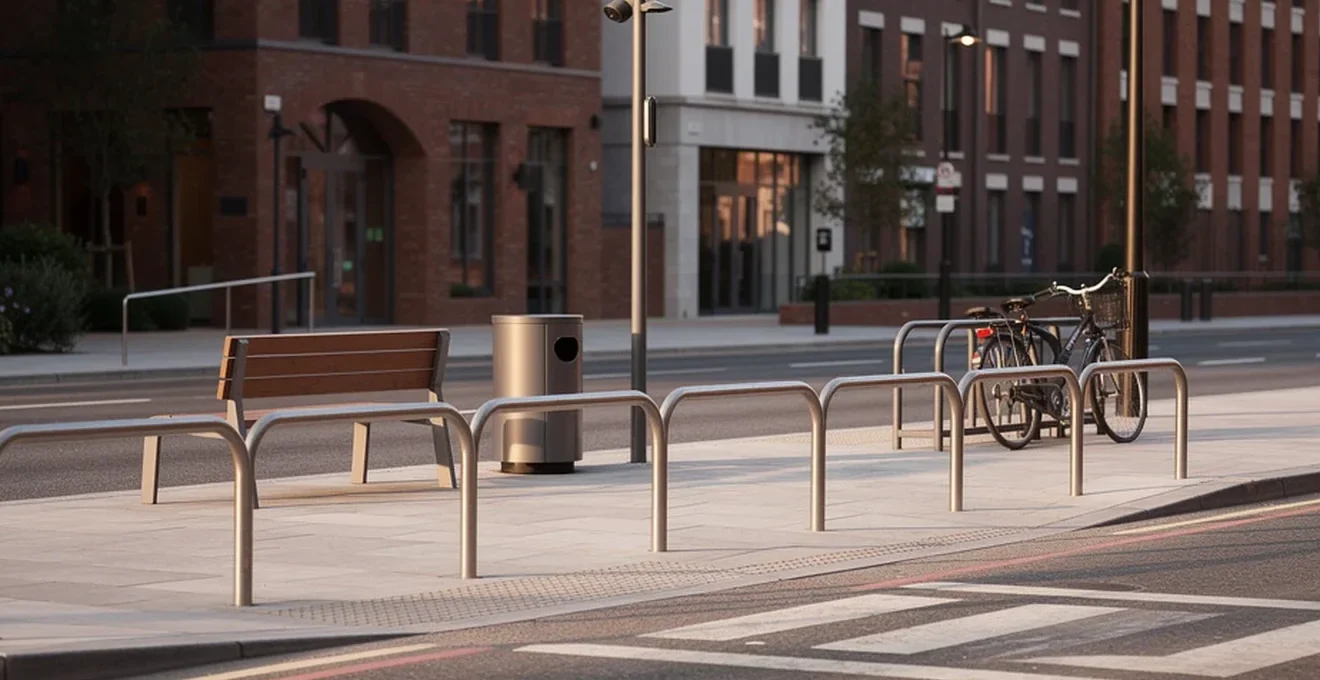
Street furniture rarely gets much thought until it fails to do its job — a bench that’s missing when you need to rest, a poorly placed bollard, an overflowing bin. Yet benches, bollards, bins, lighting and signage are quietly central to how safe, accessible and organised our public spaces feel. They shape how people move through streets, where vehicles can and can’t go, how visible pedestrians are after dark, and whether an older resident or a parent with a pushchair can comfortably use a town centre at all. As local authorities balance tighter budgets against rising expectations around safety, climate resilience and inclusivity, the specification of street furniture has become a genuinely strategic decision rather than an afterthought. This article looks at how different categories of street furniture function within urban design, the standards that govern them, and how UK cities are using them to build safer, smarter public realm.
Defining street furniture within urban design frameworks
Street furniture refers to the fixed and semi-fixed objects installed in public spaces to support movement, rest, safety and amenity. It sits at the intersection of engineering, landscape architecture and public policy — every bench or bollard has to satisfy structural, regulatory and aesthetic requirements simultaneously. Far from being decorative extras, these elements are increasingly specified as part of coordinated public realm strategies that address security, drainage, lighting and accessibility together, rather than as isolated purchases.
Core categories: bollards, benches, bins and bicycle racks
Most street furniture falls into a handful of functional categories. Bollards control vehicle movement and protect pedestrian zones, ranging from simple traffic-calming posts to certified security barriers capable of resisting vehicle impact. Benches and seating provide rest points that are essential for older people, those with mobility limitations, and anyone undertaking a longer walk through a town centre. Bins manage litter and, increasingly, incorporate smart sensor technology to signal when they need emptying. Bicycle racks and shelters support active travel by giving cyclists somewhere secure to leave their bikes near shops, transport hubs and public buildings. Each category interacts with the others: a well-placed bench near a bike rack near a bin creates a small but functional node within a wider pedestrian network.
Materials engineering: cast iron, corten steel and recycled polymers
Material choice affects durability, maintenance costs and environmental impact. Cast iron remains popular for benches and bollards where a traditional aesthetic is required, offering long service life with relatively low maintenance. Corten steel — a weathering steel that develops a stable rust-like patina — is widely used for planters and structural elements where a contemporary, low-maintenance finish is desirable, as the surface oxidation protects the metal beneath without the need for painting. Recycled polymers are increasingly specified for benches, bin surrounds and planters, offering a lower carbon footprint and resistance to weathering, while supporting circular economy objectives in public procurement.
Regulatory standards: BS EN 1090 and local authority specifications
Structural steelwork used in street furniture manufacturing is typically required to comply with BS EN 1090, the European standard governing the execution of steel and aluminium structures, which sets requirements for welding, tolerances and quality control during fabrication. Beyond this, individual local authorities often maintain their own specifications covering acceptable materials, finishes and installation methods, reflecting local heritage character, maintenance capacity and accessibility requirements. Security-rated products such as vehicle-resistant bollards and seating are additionally tested against specific impact standards, giving specifiers a certified basis for demonstrating that a product will perform as intended in a genuine security incident.
Traffic calming and pedestrian safety applications
One of the most direct ways street furniture contributes to public safety is by physically managing the interaction between vehicles and pedestrians. This isn’t limited to obvious security infrastructure; it extends to everyday design decisions about kerb lines, crossing points and road geometry.
Anti-terrorism bollards and hostile vehicle mitigation (HVM) systems
Following a series of vehicle-as-weapon attacks in crowded public spaces, hostile vehicle mitigation has become a mainstream consideration in public realm design rather than a niche specialism. Products such as security-rated bollards, seating and bins can be tested and certified to standards including IWA 14-1, which assesses resistance to impact from a vehicle of a specified weight and speed — for example, a 2.5 tonne vehicle travelling at 30mph. The advantage of this approach is that a coordinated arrangement of certified bollards, seating and planters can create an effective vehicle barrier around a high-footfall location such as a market square, event space or transport hub, without the space looking or feeling like a security installation. Most users would simply experience it as good quality street furniture, which is precisely the point: effective protection that doesn’t compromise the character or openness of the space.
Guardrails and pedestrian barriers at High-Footfall junctions
At busy junctions and crossing points, guardrails and pedestrian barriers help direct foot traffic to designated crossing locations and prevent pedestrians from stepping into the carriageway at unsafe points. While their use has reduced in some shared-surface schemes in favour of more permeable design, they remain an important safety tool at locations with high vehicle speeds, poor sightlines, or heavy footfall from schools, transport interchanges or event venues.
Tactile paving integration for visually impaired navigation
Tactile paving provides a physical, underfoot cue for pedestrians with visual impairments, marking the boundary between pedestrian and vehicle space at crossings, platform edges and other transition points. Its integration alongside other street furniture — dropped kerbs, controlled crossings and clear signage — forms part of a wider inclusive design approach that ensures streets can be navigated safely and independently by people with a range of sensory and mobility needs.
Chicanes and Build-Outs for vehicle speed reduction
Physical build-outs and chicanes narrow the carriageway at strategic points, forcing vehicles to slow down and improving sightlines between drivers and pedestrians. Often combined with planting, bollards or seating, these interventions reduce vehicle speeds without relying solely on signage, making residential streets and town centres feel calmer and safer for people on foot.
Spatial organisation through functional placement
Beyond individual safety features, the placement of street furniture shapes how people find their way, park bikes, and interact with waste infrastructure across a wider area. Thoughtful spatial organisation reduces friction in everyday journeys and supports a coherent public realm strategy.
Wayfinding signage and legible london principles
Clear, consistent signage helps pedestrians navigate unfamiliar streets with confidence, reducing reliance on smartphones and making cities more welcoming to visitors. Legible London — the wayfinding system developed for use across the capital — established principles that have influenced signage strategy more widely: consistent visual language, maps orientated to the direction of travel, and signage positioned at genuine decision points rather than scattered arbitrarily. Applying these principles helps ensure that wayfinding furniture actively assists pedestrians rather than adding visual clutter to already busy streetscapes.
Cycle parking hubs near transport interchanges
Positioning bicycle racks and shelters near stations, bus interchanges and town centre entrances supports multi-modal journeys, allowing people to cycle part of the way and switch to public transport or walking for the remainder. Concentrating cycle parking at these key nodes, rather than distributing it thinly across a wider area, makes it easier for local authorities to maintain and monitor, while giving cyclists confidence that secure parking will be available at the point they need it most.
Zoning strategies for waste management infrastructure
Bin placement affects both cleanliness and the visual character of a street. Zoning strategies typically concentrate waste infrastructure near natural litter-generating points — food outlets, transport stops, event spaces — while avoiding clusters that dominate a streetscape or obstruct pedestrian flow. Smart bin technology, discussed further below, increasingly informs these decisions by revealing where fill rates are consistently high, allowing planners to adjust bin density and collection routes based on genuine usage data rather than assumption.
Smart city integration and IoT-Enabled furniture
A growing proportion of street furniture now incorporates sensors, connectivity and renewable power, allowing local authorities to gather data and reduce operational costs simultaneously.
Solar-powered lighting bollards with motion sensors
Integrating solar-powered LED lighting into bollards, seating and other street furniture allows illumination to be placed precisely at natural gathering points, without the need for mains connections, extensive groundworks or lengthy installation programmes. This matters because the evidence on lighting and safety is compelling: research from the College of Policing found that improved street lighting can reduce overall crime by around 21% in areas where it is introduced, with particular benefits for property crime and for people’s perception of safety. Motion-sensor variants further reduce energy consumption by dimming when an area is unoccupied and brightening as pedestrians approach, extending battery life while still delivering illumination exactly when and where it’s needed. For councils under pressure to cut costs while meeting net zero commitments, solar lighting solutions deliver on both fronts at once.
Connected bins with Fill-Level monitoring technology
Traditional bin collection follows fixed schedules regardless of actual fill levels, resulting in wasted vehicle journeys and bins that overflow on unexpectedly busy days. Smart bins address this directly. Fill-level sensors transmit real-time data to collection teams, allowing emptying to be scheduled according to genuine need rather than a fixed rota, while internal solar-powered compaction can increase effective bin capacity several times over compared with a conventional unit. The result is fewer collection vehicle movements — cutting emissions, fuel costs and congestion — combined with bins that rarely overflow even during peak footfall periods. The higher upfront cost of this infrastructure is typically recovered through reduced collection frequency within a relatively short timeframe.
Digital kiosks and Real-Time transit information displays
Digital kiosks and transit displays extend the wayfinding function of traditional signage, giving pedestrians live departure information, local area maps and, in some cases, charging points or emergency contact facilities. Positioned at transport interchanges and high-footfall public spaces, they reduce uncertainty around journey planning and can support wider place-making objectives by promoting local events, businesses and services.
Case studies from UK urban regeneration schemes
Several UK regeneration projects illustrate how street furniture decisions are embedded within wider public realm strategy.
Exhibition road, london: shared surface design approach
Exhibition Road in South Kensington is a widely referenced example of shared surface design, where the traditional separation between carriageway and pavement was replaced with a continuous, patterned surface used by pedestrians, cyclists and vehicles alike. Street furniture on the scheme — including bollards, seating and lighting columns — was designed to be minimal and carefully positioned, doing the work that kerbs and barriers would otherwise perform: guiding movement and defining space without visually dominating the street. It’s frequently cited in urban design discussions as a demonstration of how the strategic placement of a small number of well-designed elements can achieve safety objectives while significantly opening up a streetscape.
Manchester’s northern quarter streetscape overhaul
Manchester’s Northern Quarter has undergone streetscape improvements aimed at supporting its character as a creative and hospitality-led district, with public realm interventions designed to accommodate high footfall, outdoor seating for cafés and bars, and cycle parking to support the area’s popularity with younger residents and visitors. The area’s regeneration reflects a broader pattern seen across UK cities: streetscape investment concentrated in areas with strong existing pedestrian activity, using furniture choices to reinforce local identity while addressing practical circulation and safety needs.
Birmingham’s big city plan and public realm strategy
Birmingham’s long-term city centre strategy has placed significant emphasis on public realm quality as part of a wider effort to improve pedestrian connectivity between key destinations and reduce the dominance of vehicle infrastructure in the city core. Coordinated street furniture — including seating, lighting and signage — has formed part of efforts to stitch together previously disconnected areas of the city centre, supporting the wider objective of making Birmingham more walkable and encouraging longer visitor dwell times.
Sustainability considerations in street furniture procurement
As local authorities work towards net zero commitments, the environmental credentials of street furniture procurement have become as important as its functional performance.
Circular economy principles and End-of-Life recyclability
Specifying street furniture with circular economy principles in mind means considering not just the materials used in manufacture, but what happens at the end of a product’s service life. Steel and cast iron elements are generally highly recyclable, while recycled polymer benches and bin surrounds reduce demand for virgin material at the outset. Modular products — such as planter systems that can be reconfigured or relocated rather than replaced — extend useful life and reduce the volume of street furniture sent to landfill when public realm schemes are updated.
Low-carbon manufacturing certifications and BREEAM compliance
Public sector procurement increasingly requires evidence of environmental performance alongside cost and durability, and street furniture manufacturers are responding with lower-carbon production processes and materials sourced with reduced embodied carbon. Where street furniture forms part of a wider development or regeneration scheme, its specification can also contribute to the project’s overall BREEAM assessment, the sustainability rating scheme widely used in UK construction, by supporting credits related to materials sourcing, water management and ecological value — for instance, through planters and permeable surfaces that contribute to sustainable drainage strategies. Considered this way, street furniture is not a peripheral line item but a genuine contributor to a scheme’s broader sustainability performance.